

Behind the Screen: How Modern Scammers Perfectly Impersonate Your Bank

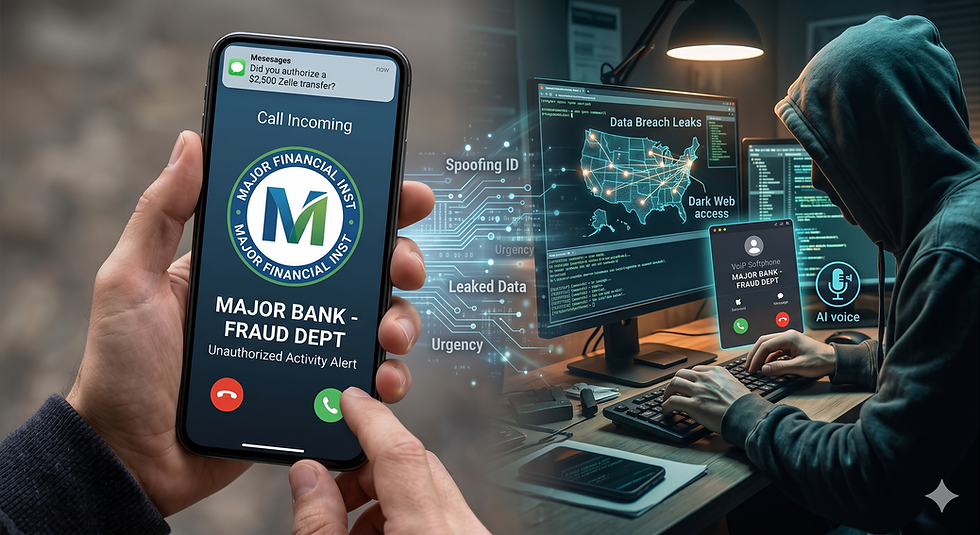
It's a scenario that causes an immediate spike in adrenaline: Your phone buzzes with a text message or a phone call displaying your bank’s exact name on the caller ID.
The person on the other end—or the text alert on your screen—claims there is "unauthorized fraudulent activity" on your account. Someone is trying to drain your life savings, and you need to act right now.
If you panic and follow their instructions, you don’t stop a theft. You unwittingly execute it.
Bank impersonation scams have skyrocketed, costing consumers and businesses billions of dollars annually. According to the FBI and FTC, financial imposter schemes are among the fastest-growing fraud categories. What makes them so terrifyingly effective is that today's fraudsters are no longer relying on poorly written emails; they are using highly sophisticated, tech-driven tactics that make them virtually indistinguishable from real bank representatives.
Here is a look behind the curtain at exactly how these scammers operate, and the psychological levers they pull to bypass your defenses.
1. The Tech Stack of a Financial Imposter
Scammers don't just guess your bank and hope for the best. They utilize a powerful toolkit of modern technology to stage a flawless performance.
Spoofing Caller ID and Short Codes
Through easily accessible Voice over IP (VoIP) and spoofing software, criminals can alter what appears on your phone’s display. They can make an incoming call display the exact name of your financial institution, or even match the phone number printed on the back of your debit card. Similarly, text messages can be spoofed to slip directly into the existing text thread you have with your bank, right below legitimate security alerts you received months ago.
Data-Enriched Phishing
Have you ever wondered how a scammer knew your account number, or even your exact balance down to the penny? Fraudsters purchase massive bundles of leaked personal data from the dark web resulting from corporate data breaches. Armed with your name, phone number, and partial account details, they will even call your bank’s automated tele-banking system ahead of time to scrape your real-time balance. When they read this information back to you, your skepticism instantly evaporates.
AI Voice Cloning and Deepfakes
The weaponization of artificial intelligence has changed the game. Scammers can use AI to mimic the professional tone, hold music, and scripted language of a standard banking call center. In more advanced commercial scams, bad actors use a few seconds of an executive's voice harvested from social media to call an accounting department and authorize an "urgent wire transfer."
2. The Mechanics of the "Safe Account" Trap
While the entry points differ—whether it's a call (vishing), a text (smishing), or an email—the end-game usually follows a highly calculated script. The most common blueprint is the "Safe Account" or "Reverse Fraud" scam.
[Fake Fraud Alert Text/Call] ➔ [Manufacture Extreme Urgency] ➔ [Request One-Time Passcode] ➔ [Instruct Victim to Move Funds to a "Secure Account"]
The Hook: The scammer alerts you to a fake unauthorized transfer (e.g., "Did you just authorize a $2,500 transfer to Walmart?"). When you reply "NO," they pretend to step in as the savior.
The Credential Harvest: To "verify your identity," they trigger a real password reset or one-time passcode (OTP) from your actual bank's app. They ask you to read that code back to them. By giving them that code, you have just handed them full access to your online banking portal.
The Cleanout: Once inside your account, they tell you that your checking account is compromised and compromised by "corrupt bank employees." To protect your money, they instruct you to link your account to Zelle, use a wire transfer, or withdraw cash to deposit into a "secure, government-protected account."
The moment you authorize that transfer, the money hits a money mule account and vanishes forever. Because you authorized the transfer under the bank's security protocols, recovering those funds from your financial institution is incredibly difficult.
3. Psychological Traps: Why Clever People Fall For It
Scammers don't succeed because their victims are gullible; they succeed because they hijack human psychology.
Manufactured Urgency: They give you no time to think. They will tell you that if you hang up, your funds will be permanently lost within minutes. Under extreme stress, the logical part of the human brain shuts down, forcing us into a reactive, emotional state.
The Authority Bias: They leverage the names of major brands (Chase, Bank of America, Wells Fargo) or even invoke federal law enforcement, claiming they have "FBI agents on standby" to help track the hackers.
Exploiting Isolation: A major red flag is when a caller insists you keep the conversation a secret. They will instruct you not to talk to the tellers at your local branch because "the branch staff is currently under internal investigation." This prevents a real human professional from stepping in to stop the transaction.
How to Absolute-Proof Your Wallet
Protecting yourself requires adopting a strict mentality of zero-trust when it comes to unexpected financial communications.
The Universal Banking Rule: A legitimate financial institution will never call or text you out of the blue and ask you to move your money to a different account, convert it to cryptocurrency, or read back a one-time security passcode.
If you receive a suspicious alert, remember these three steps:
Hang Up Immediately: Do not argue, do not try to verify them, and do not use any phone numbers they provide.
Call the Source: Flip your debit or credit card over. Dial the exact phone number printed on the back of the physical card, or type your bank’s official URL directly into a secure browser. Ask their fraud department if the previous call was legitimate.
Enable Real-Time Alerts: Turn on push notifications within your bank’s official app for every transaction. This ensures you always know what is actually happening with your money, independent of text messages or phone calls.
The digital world moves incredibly fast, and fraud tactics will only become more sophisticated. The best defense is a simple one: pause, hang up, and verify on your own terms.


Comments