

🤖 The AI Arms Race: How Hackers are Scaling the "Dark Side" in 2026

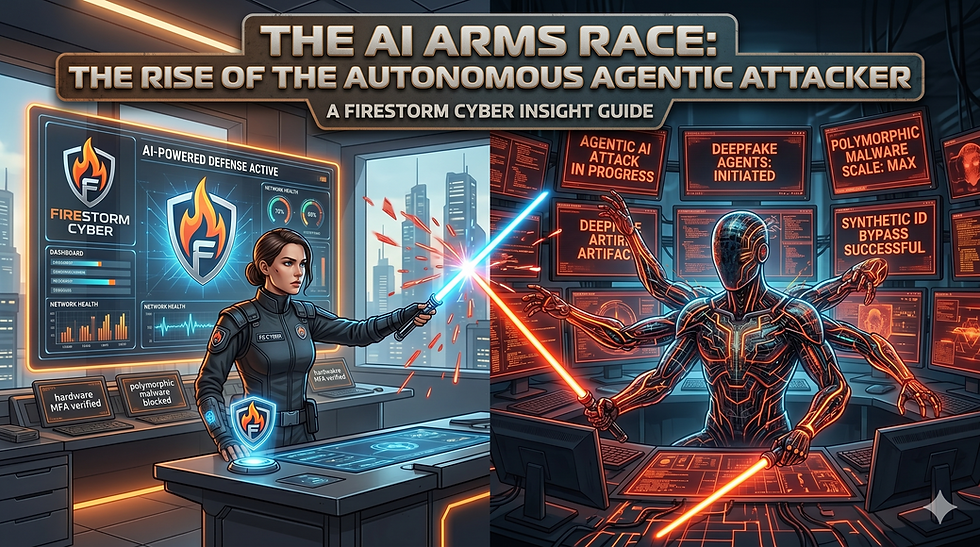
It’s May 4th, and while we’re celebrating the heroic Jedi, there’s a real-world "Empire" of cybercriminals using high-tech tools to strike back. Today, the game has changed. We are no longer just fighting human hackers; we are fighting Agentic AI.
At Firestorm Cyber, we’ve seen a massive shift in how threats are deployed. Scammers are no longer manual laborers; they are now the "architects" of automated attack machines. Here is how AI is helping them up their game.
1. The Rise of the "Agentic" Attacker
The most significant trend now is the shift from AI "assistants" to Autonomous AI Agents. * The Old Way: A hacker would manually scan a network for hours to find a vulnerability.
The AI Way: Hackers now deploy agents like "Claude Code" variants or custom "Dark LLMs" that can handle 80–90% of an attack chain without human intervention. They scan, identify valuable data, and even negotiate ransoms based on a company’s public financial data—all at machine speed.
2. The "Democratization" of Deepfakes
Deepfake technology has moved out of the lab and into the hands of entry-level scammers.
Hyper-Personalized Phishing: Gone are the days of "Dear Valued Customer" emails with typos. AI now scrapes your social media to write emails that sound exactly like your boss or a family member.
Real-Time Impersonation: Scammers are using Deepfake-as-a-Service to impersonate CEOs in video calls or use voice cloning to trick employees into authorizing fraudulent wire transfers. In 2025 alone, deepfake fraud caused over $1.6 billion in losses—and 2026 is on track to smash that record.
3. Malware That "Learns"
Traditional antivirus software works by looking for "signatures" of known viruses. Modern AI-driven malware is polymorphic.
It can change its own code as it moves through a network to avoid detection.
It uses AI to identify your most critical backups first, ensuring that when the "firestorm" hits, you have no way to recover without paying.
4. Bypassing the Front Door (Biometrics)
Think your face or fingerprint is 100% secure? AI "fraud agents" are being used to bypass biometric checks by submitting AI-generated synthetic identities and high-fidelity deepfake videos that trick verification interfaces in real-time.
🛡️ How to Stay in the Light
You cannot fight machine-speed attacks with human-speed responses. To stay protected, you need a defense that thinks as fast as the threat:
Deploy AI-Powered Defense: Use security tools that use machine learning to spot anomalies (like a login at 3 AM from a new location) before they escalate.
Hardware-Based MFA: Move beyond SMS codes. Physical security keys are one of the few things AI can't "spoof" or phish.
The "Human" Verification: If you receive a strange request—even if it sounds and looks like someone you know—verify it through a different channel (e.g., call them back on a known number).
Firestorm Cyber is at the forefront of this digital arms race. We use the latest in AI-driven monitoring to ensure your business stays secure in a world of autonomous threats.
Is your defense ready for the age of AI? Get a Firestorm Security Assessment and don't let the machines win.


Comments